
Contract page 1
Footage gets a 30-day retention promise
The contract gives residents a 30-day footage retention promise, but later language treats data created from those videos and photos differently.
Contract evidence
The contract focuses on footage: video and photos. But it also allows Flock to analyze that footage, turn it into data, and use that data to improve its systems over time.
Even if video and photos are deleted, the information learned from them can continue to be used.
Short version
Video and photos can be deleted.
The data created from them can still live on.
The contract does not clearly block the sale, export, or monetization of machine-learned data derived from the images.
Data loophole
The contract focuses deletion limits on Footage, while separate language lets Flock analyze video and photos, create anonymized data, and use it to improve systems.
Anonymized data
The contract grants broad rights around anonymized data, but residents still need clear limits, testing, and oversight when data can be combined with other datasets.
Future use
The language allows data to improve services, related systems, technologies, and other Flock offerings without a public expiration date for derived insights.
Access and sharing
The product description includes statewide, nationwide, direct-share, time-and-location, and license-plate history search features.
Oversight gaps
Residents are left with broad compliance language, but no clear warrant rule, independent audit requirement, public reporting requirement, or specific penalties for misuse.
Plain-English concern
The footage may be temporary. The data isn't clearly temporary. The contract says Footage is deleted on a rolling retention schedule, but it separately lets Flock collect, analyze, anonymize, use, distribute, and improve systems with data created from those videos and photos.
Anonymized does not always mean untraceable in practice. When data is stripped of direct identifiers, it can still be combined with other datasets, used to find patterns, and sometimes linked back to real-world identities in certain contexts.
The more sources that are combined, the easier it can become to connect patterns back to individuals. That is why this is not just about cameras. It is about how data is created, combined, and used over time.
Highlighted source sections
These screenshots come from the Casa Grande contract with Flock Group Inc. The highlights show the clauses behind the plain-English concerns on this page.
Contract excerpts are shown for public-interest commentary and source attribution. The full contract PDF is linked so readers can review the complete record in context.
Contract page 1
The contract gives residents a 30-day footage retention promise, but later language treats data created from those videos and photos differently.
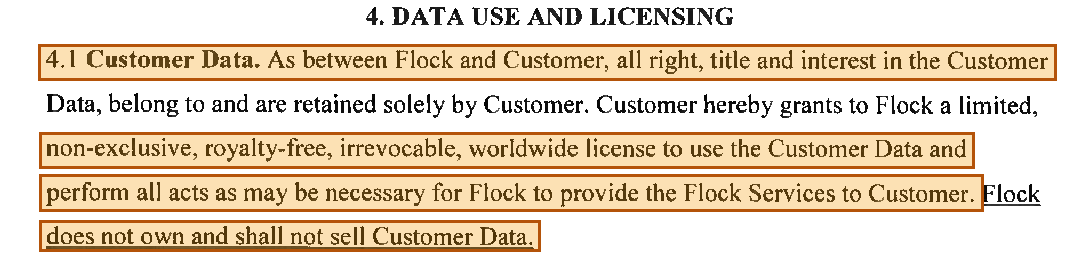
Contract page 6 / Section 4.1
The no-sale language is important, but it is aimed at Customer Data. The bigger concern is whether the contract blocks use, export, or monetization of data learned from the images.
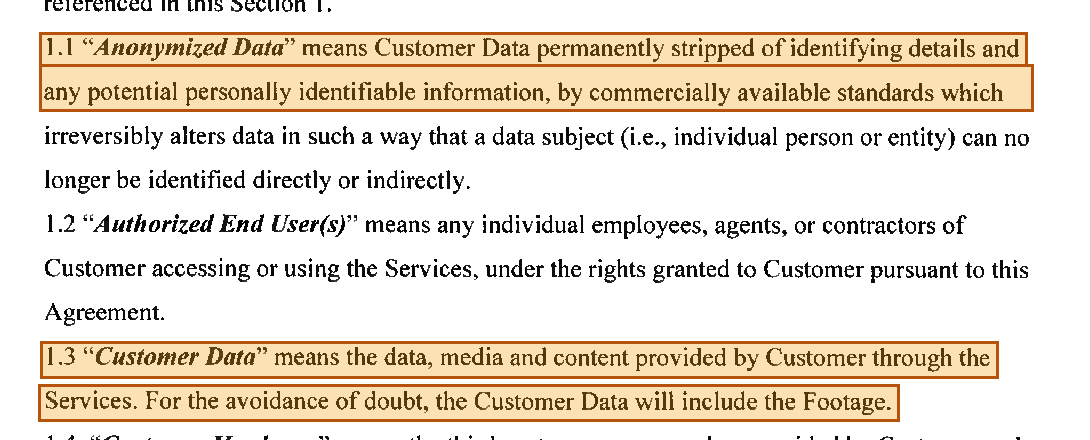
Contract page 2 / Sections 1.1 and 1.3
Anonymized does not always mean untraceable in every real-world setting. The more sources that are combined, the easier it can become to connect patterns back to people.
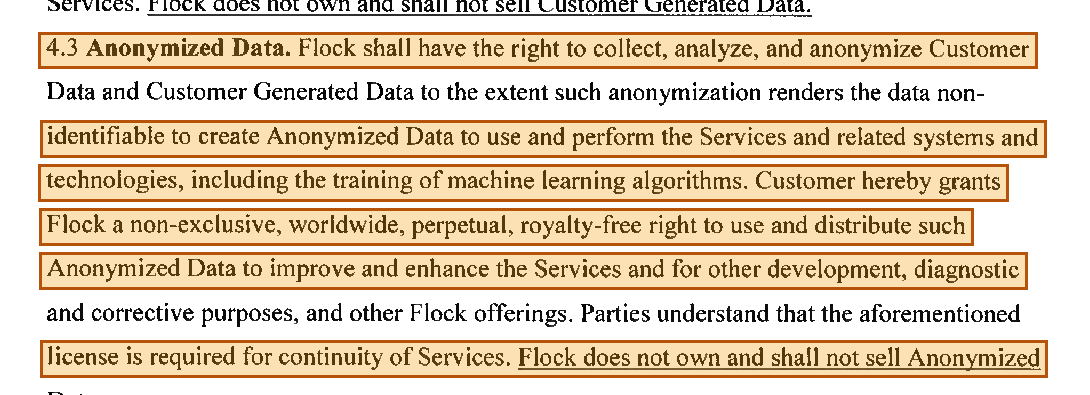
Contract page 7 / Section 4.3
This is the core weakness: video and photos can be deleted, but information learned from them can still help train and improve the system.

Contract page 9 / Section 5.3
This does not mean every disclosure will happen, but it shows why access rules, audit logs, and clear public limits matter.
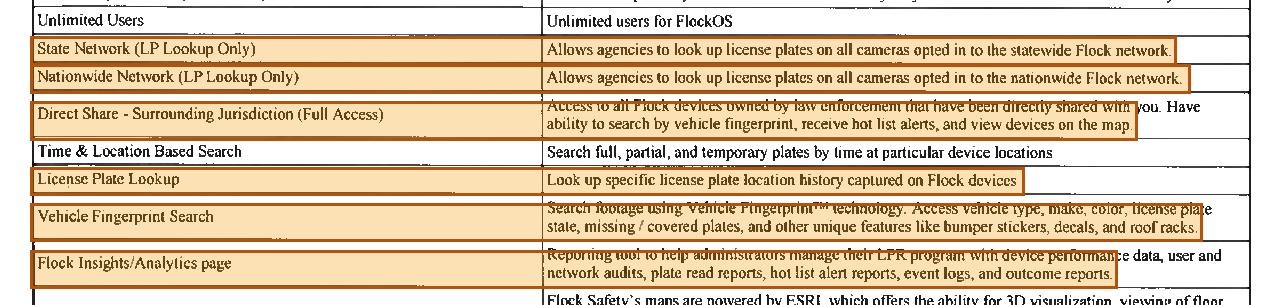
Contract page 25 / FlockOS features
When location data is combined with other databases, a vehicle search can start revealing patterns about real people, not just cars.

Contract page 15 / Section 11.1
The contract governs the technology relationship. It does not add the constitutional safeguards, search-scope limits, or independent oversight residents are asking for.
Key weaknesses in the contract
These weaknesses do not require guessing about secret behavior. They come from what the contract says, what it does not say, and what residents should demand in enforceable public rules.
The contract protects video and photos more clearly than the data created from them.
The contract lets Flock analyze video and photos, create anonymized data, and use that data to improve systems.
There is no clear expiration date for anonymized or derived data used to train and improve Flock systems.
The contract allows improvement, development, diagnostics, correction, and other Flock offerings without narrow public boundaries.
The contract does not require third-party audits, public reporting, or independent verification of compliance.
The contract does not create clear misuse penalties, defined consequences, or public enforcement mechanisms for abusive searches.
The contract leaves residents without plain answers about exactly who can access the system and how interagency sharing is controlled.
The agreement does not require warrants, probable cause, or search-scope limits for sensitive location-history searches.
Bottom line
The petition asks for stronger limits on derived data, warrants or comparable standards for sensitive searches, independent audits, public reporting, and clear consequences for misuse.