Cost and results

240 devices for 60,000 people. 73 arrests in 26 months.

CGPD cites serious cases like homicides. It gives no numbers.

Here are the numbers.

Casa Grande approved a roughly 10-year, $10 million Safe City/Flock contract, which averages about $1 million per year before considering reported taxes and later-year annual costs.

The handout gives no numbers on results. The department has them. A table attached to the January 30, 2026 email counts every arrest from a camera hit since December 2023: 73 in 26 months, about 3 a month. Four were violent crimes.

100

License Plate Reader Cameras

100

Pan Tilt Zoom Cameras

31

Gun Shot Detection Systems

The same money

13 officer salaries a year

Casa Grande lists Police Officer base pay at $63,714-$87,824, a $74,762 midpoint. $1,000,000 / $74,762 = about 13 officer base salaries. Benefits and equipment add cost, so this is not a full staffing budget. It shows the tradeoff.

Results

73 arrests in 26 months. The department's own count.

The city told the council

“The department has used ALPR and PTZ technology to assist with criminal investigations and public safety incidents ... in serious cases such as homicides, aggravated assaults, and drive-by shootings.”
Chief's agenda document, page 9

The record shows

The handout gives no numbers. The department has them. The same January 30 email attached a table of every arrest from a camera hit since December 2023.

The total is 73 arrests in 26 months. That is about 3 a month. 35 were car or property crimes, 21 were drug cases, 11 were warrants, 2 were weapons cases. Four were violent crimes. Three months had none.

The program costs about $1 million a year, about 13 police officer salaries. In 2025 alone, officers ran about 17,500 searches. The department counted 23 arrests from camera hits that year.

73

arrests from camera hits in 26 months, 4 of them violent

The department's own table

"Monthly Arrest Breakdown by Offense Type," attached to the January 30, 2026 email. Every arrest from a camera hit since December 2023, by month. Tap to open page 3 and page 4.
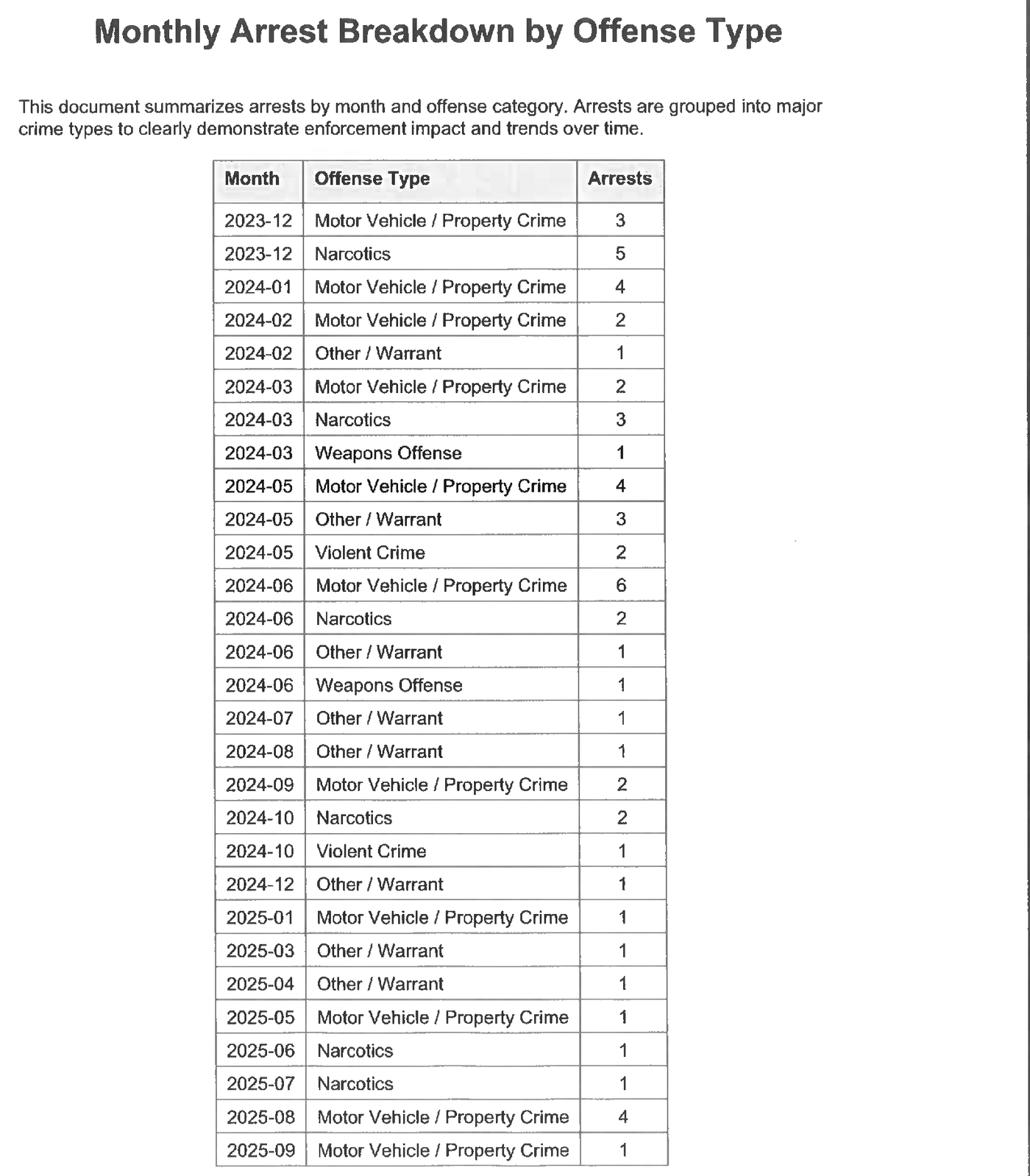
The police department's own table titled Monthly Arrest Breakdown by Offense Type, listing arrests from license plate reader hits by month from December 2023 onward.

See it yourself

Scale

Roughly one device for every 250 residents.

Map of Casa Grande covered with blue Flock camera location markers across major roads and neighborhoods.
Casa Grande's Flock coverage map shows cameras across major roads and neighborhoods. Map image courtesy of deflock.org.

License Plate Reader (LPR) Cameras

The city says they identify vehicles associated with investigations, not individuals. But LPRs capture image records, plate reads, timestamps, and locations that can reconstruct where people travel over time.

Pan-Tilt-Zoom (PTZ) Cameras

The city says trained personnel operate them during incidents. In practice, zoomable cameras can follow any person in view, including women and children, not just people suspected of crimes.

Drone as First Responder (DFR)

Marketed as aerial support for faster response, but drones can also let police look into backyards and other private outdoor spaces.

Gunshot Detection System

The city says it detects gunfire and does not record conversations. EFF warns Flock gunshot-detection microphones are being expanded to listen for human voices and distress sounds.

Read the EFF warning

Flock OS Platform

Connects the surveillance network into one platform. Flock has described integrations that can combine camera data with OSINT-style information, including online profiles, posts, addresses, and identity clues.

The city told the council

“Is ALPR technology used for general surveillance? No.”
Chief's agenda document, page 3

The record shows

The cameras photograph every car that passes, whether or not anyone is suspected of anything, and keep the record for 30 days. That is the definition of general surveillance. Only the search is targeted.

The handout says the goal is "citywide coverage." It also admits investigators check whether a car "was in a particular area during a relevant timeframe." That kind of search returns every innocent car that drove by.

The plan is about 240 devices for about 60,000 people, including 100 video cameras that record all the time. That is roughly one device for every 250 residents.

240

devices for a city of about 60,000 people

See it yourself

Casa Grande should prove this spend reduces serious crime before locking in ten years of it.

Bottom line

Ask the council what counts as a good result for $1 million a year.

Cameras do not patrol, de-escalate, interview witnesses, or build trust. The same money would fund about 13 sworn officers.