

September 8 study session

The City Council Study Session Is a PR Campaign for Flock.

On Tuesday the Police Chief will present the Flock camera program to City Council. No public comment is allowed. The city already released his 11-page handout, and it reads like a Flock press release.

We checked every page against the city's own records. Twelve claims, in plain English, each with a link to the exact page of proof that their claims don't add up.

Come. But read this first.

Tuesday, September 8, 2026

Study session
6:00 PM. Study session on the "Safe City" camera program. No public comment.
Right after
7:00 PM. Regular council meeting. Public comment allowed.
Where
City Hall, 510 E Florence Blvd, Casa Grande, AZ 85122
On the agenda
B.1 Presentation, Update, and Discussion Regarding the Safe Cities Program by Chief of Police of Casa Grande

What the chief says. What the record shows.

Every quote is the city's own words. Every number comes from records the city released. Names in the search logs appear as the city released them.

  1. 1

    They say

    “No. CGPD does not share ALPR and PTZ data with Federal Agencies including Immigration and Customs Enforcement (ICE).”
    Handout, page 6

    Evidence tells another story

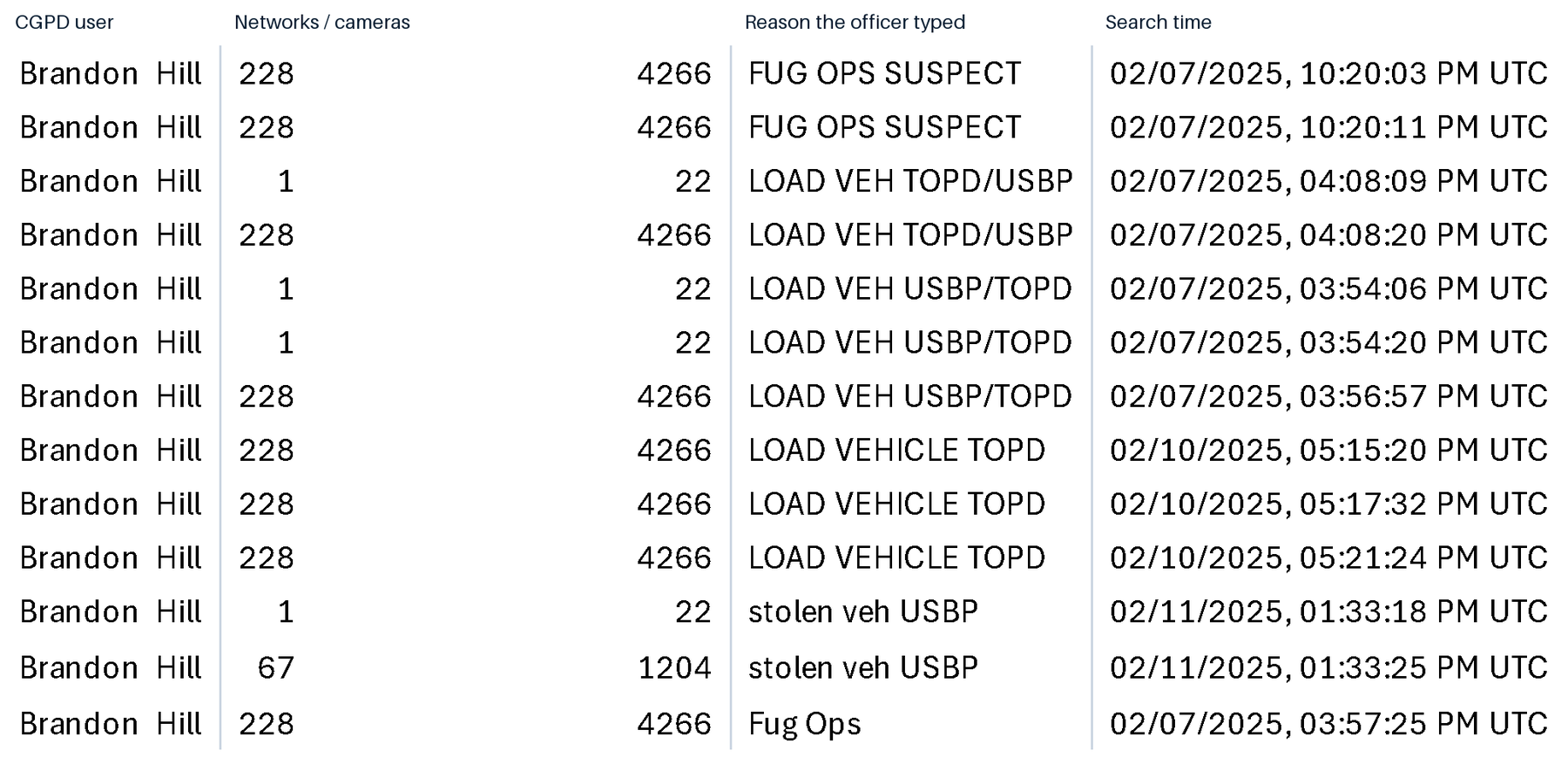
    The city's own search logs say otherwise. The Casa Grande PD account of Brandon Hill ran 42 searches between January 3 and March 3, 2025 with reasons like "target veh USBP," "target veh ERO," "ERO FUG OPS," and "USMS/ERO," plus 5 more "load vehicle" searches with the tribal police on the border. Some covered more than 300 camera networks and 5,000 cameras.

    This is the pattern 404 Media documented in May 2025: ICE has no Flock contract, so local officers run the searches for it. We do not know the arrangement here, and these searches happened before the September 2025 contract. The handout speaks in the present tense and says "No."

    Even if it stopped tomorrow, a city policy cannot bind the federal government. A subpoena compels Flock directly, and the contract lets Flock hand footage to "law enforcement authorities, government officials, or third parties."

    42

    searches labeled for Border Patrol, ICE, or the US Marshals

    Excerpt from the February 2025 Casa Grande search log showing thirteen searches by Brandon Hill with reasons FUG OPS SUSPECT, LOAD VEH TOPD/USBP, LOAD VEH USBP/TOPD, LOAD VEHICLE TOPD, stolen veh USBP, and Fug Ops, some across 228 networks and 4,266 cameras.
    February 2025 search log, page 9, as released by the city. Tap to open the page.

    What the codes mean

    USBP
    U.S. Border Patrol, part of Customs and Border Protection.
    ERO
    Enforcement and Removal Operations, the part of ICE that arrests and deports people.
    Fug Ops
    ERO's Fugitive Operations teams, which look for people with deportation orders.
    USMS
    U.S. Marshals Service.
    TOPD
    Tohono O'odham Police Department, the tribal police on the Arizona border, which works closely with Border Patrol.
    Load veh
    Border-enforcement slang for a car suspected of carrying smuggled people.
    ATL
    "Attempt to locate."

    47 searches in all, across the January, February, and March 2025 logs, from the account of Brandon Hill, Casa Grande AZ PD, January 3 to March 3, 2025. Most carry a single code, 4Z15BR254Z0001, or no case number at all. "Networks" are other agencies' camera systems.

    See the evidence yourself

  2. 2

    They say

    “The cameras do not have or use facial recognition technology, nor can users search the system based on a person's face or facial features, gender, or ethnicity.”
    Handout, page 4

    Evidence tells another story

    Officers can, and did. Flock sells a search box called FreeForm, and Casa Grande has it turned on. From October 2025 through January 2026 the logs show 84 searches for people by description. Stephanie Sjerven typed "male." Damian Guerrero typed "female wearing grey sweater." Kyle Short typed "person wearing black hoodie and black hat." Jeffrey McKean typed "child."

    On December 9, 2025, Damian Guerrero typed "native female wearing grey hoodie with green lettering and black pants." Flock blocked it. Thirteen seconds later he typed the same thing without "native." It went through.

    On October 21, 2025, Caleb Zadareky typed "hispanic male with a grey shirt, beanie, blue jeans and a backpack." Blocked. Later that day Christopher Mendez ran the same description without "hispanic" across 353 networks. Allowed.

    Many of these searches were for runaways and missing people. That may be good police work. It is still a capability the council was told does not exist, and Flock's own patent describes sorting people by "male, female, race," clothing, and "height and weight."

    84

    searches for people by description in four months

    The handout, page 4

    Excerpt from page 4 of the city's handout: The cameras do not have or use facial recognition technology, nor can users search the system based on a person's face or facial features, gender, or ethnicity.

    The search log, December 2025, page 44

    Excerpt from the December 2025 Casa Grande search log showing a FreeForm search for "native female wearing grey hoodie with green lettering and black pants" marked block, followed 13 seconds later by the same search without "native" marked allow.
    Blocked at 3:01:00. Allowed at 3:01:13. Tap to open the page.

    All 84 people searches by month: October 2025: 2. November 2025: 47. December 2025: 25. January 2026: 10. Every one is in the released logs linked below.

    See the evidence yourself

  3. 3

    They say

    “Does CGPD use ALPR to monitor First Amendment activity? No.”
    Handout, page 8

    Evidence tells another story

    On January 30, 2026, a deputy chief emailed command staff a list of "notable wins" from the camera system's first ten days of live monitoring. One of them: "Monitoring of a student protest at City Hall."

    The same email says the officer watching the cameras can "identify involved parties" and "monitor activity prior to patrol arrival," and that officers used the cameras to spot "suspicious activity, primarily in park areas."

    The department's written policy only bans monitoring people "based solely on" politics. Watching a protest for "public safety" slips right through that word. The handout promises more than the policy does.

    10 days

    of live monitoring before a student protest made the "wins" list

    See the evidence yourself

  4. 4

    They say

    “Do the cameras record audio? No. ALPR, PTZ, and DFR cameras do not record audio.”
    Handout, page 3

    Evidence tells another story

    Read the list again. Plate cameras, video cameras, drones. The 31 gunshot-detection devices are missing from it. Those are microphones.

    One page earlier, the handout says the gunshot system detects "gunfire and other critical public safety events." A microphone cannot tell a gunshot from a scream without listening to everything.

    Flock has announced that these microphones will start listening for human "distress" sounds.

    31

    gunshot microphones left off the "no audio" answer

    See the evidence yourself

  5. 5

    They say

    “Currently, CGPD shares ALPR data with law enforcement agencies within Arizona.”
    Handout, page 6

    Evidence tells another story

    The logs show Casa Grande officers searching far beyond Arizona. Of 18,413 searches in 13 months, 5,406 reached 100 or more camera networks and 62 reached 1,000 or more. One theft search in late November 2025 covered 6,504 networks and 97,758 cameras. That is the whole country.

    Sharing on Flock normally runs both ways. If Casa Grande can search other agencies' cameras, ask which agencies can search ours. The handout does not say.

    169 searches were labeled "Agency Assist." The handout does not say for whom.

    6,504

    camera networks reached by a single Casa Grande search

    See the evidence yourself

  6. 6

    They say

    “Are searches logged and audited? Yes. ... CGPD has several layers of oversight.”
    Handout, page 7

    Evidence tells another story

    Every layer in the handout is the department checking itself. Sergeants check officers. Lieutenants check sergeants. The "Audit Assistance Tool" is Flock's software checking Flock's customers. The Chief decides. There is no outside audit, and the handout does not promise one.

    The department's own policy says every search needs a case number and a reason. We read all 18,391 searches in the released logs. 10,954 have no case number at all: blank, "none," a word, or a few digits. Another 1,452 use a placeholder like "2025-00000000." That leaves 12,406 searches, two out of three, with no real case number. We counted anything that looked like one, even a five-digit number.

    The reasons are not much better. 2,791 searches give no reason. 7,446 more give only a word: "ATL" (3,194 times), "investigation" (2,522), "suspicious" or "suspect" (420), "test" or "training" (99). Put together, 7,089 searches, about 4 in 10, have no real case number and no real reason. The border and immigration searches mostly carry one code, "4Z15BR254Z0001," or nothing.

    The audit only records searches. It does not record an officer watching live video, so monitoring a protest would never show up in it. And when Flock flagged two searches for race, the policy says they go up the chain to the Chief. The handout does not say whether that happened.

    12,406

    searches with no real case number. That is 2 out of 3.

    See the evidence yourself

  7. 7

    They say

    “Is ALPR technology used for general surveillance? No.”
    Handout, page 3

    Evidence tells another story

    The cameras photograph every car that passes, whether or not anyone is suspected of anything, and keep the record for 30 days. That is the definition of general surveillance. Only the search is targeted.

    The handout says the goal is "citywide coverage." It also admits investigators check whether a car "was in a particular area during a relevant timeframe." That kind of search returns every innocent car that drove by.

    The plan is about 240 devices for about 60,000 people, including 100 video cameras that record all the time. That is roughly one device for every 250 residents.

    240

    devices for a city of about 60,000 people

    See the evidence yourself

  8. 8

    They say

    “Casa Grande PD Flock ALPR cameras do not: Use facial recognition. Identify people by their faces.”
    Handout, page 5

    Evidence tells another story

    That describes Flock's software. It does not describe what an officer can do with a picture. Nothing in the handout or the department's policy stops an officer from taking a face from a camera image and running it through another tool, like Clearview AI.

    Every "do not" on that list is about the plate cameras. The 100 video cameras "continually record activity in their field of view." That is the handout's own sentence, and the people searches above ran against those video cameras. Whenever a promise says "ALPR," ask what the same promise looks like for the video cameras, the drones, and the microphones.

    100

    video cameras that "continually record activity"

    See the evidence yourself

  9. 9

    They say

    “Under the City's contract and applicable Flock policies, Flock does not independently sell or share CGPD's ALPR or PTZ data for commercial purposes.”
    Handout, page 6

    Evidence tells another story

    Notice the words "independently" and "for commercial purposes." Now read the contract.

    The city gives Flock a "non-exclusive, royalty-free, irrevocable, worldwide license" to use the data. Flock may also "collect, analyze, anonymize" it and use it to "train machine learning algorithms," with a "worldwide, perpetual, royalty-free" right to what it learns.

    Not sold is not the same as not used. Casa Grande pays $10 million and hands Flock the raw material for its AI for free. Google pays for the imagery it collects. Flock gets Casa Grande's from taxpayers.

    $10M

    paid to Flock, which keeps a forever license to what it learns

    See the evidence yourself

  10. 10

    They say

    “The department has used ALPR and PTZ technology to assist with criminal investigations and public safety incidents ... in serious cases such as homicides, aggravated assaults, and drive-by shootings.”
    Handout, page 9

    Evidence tells another story

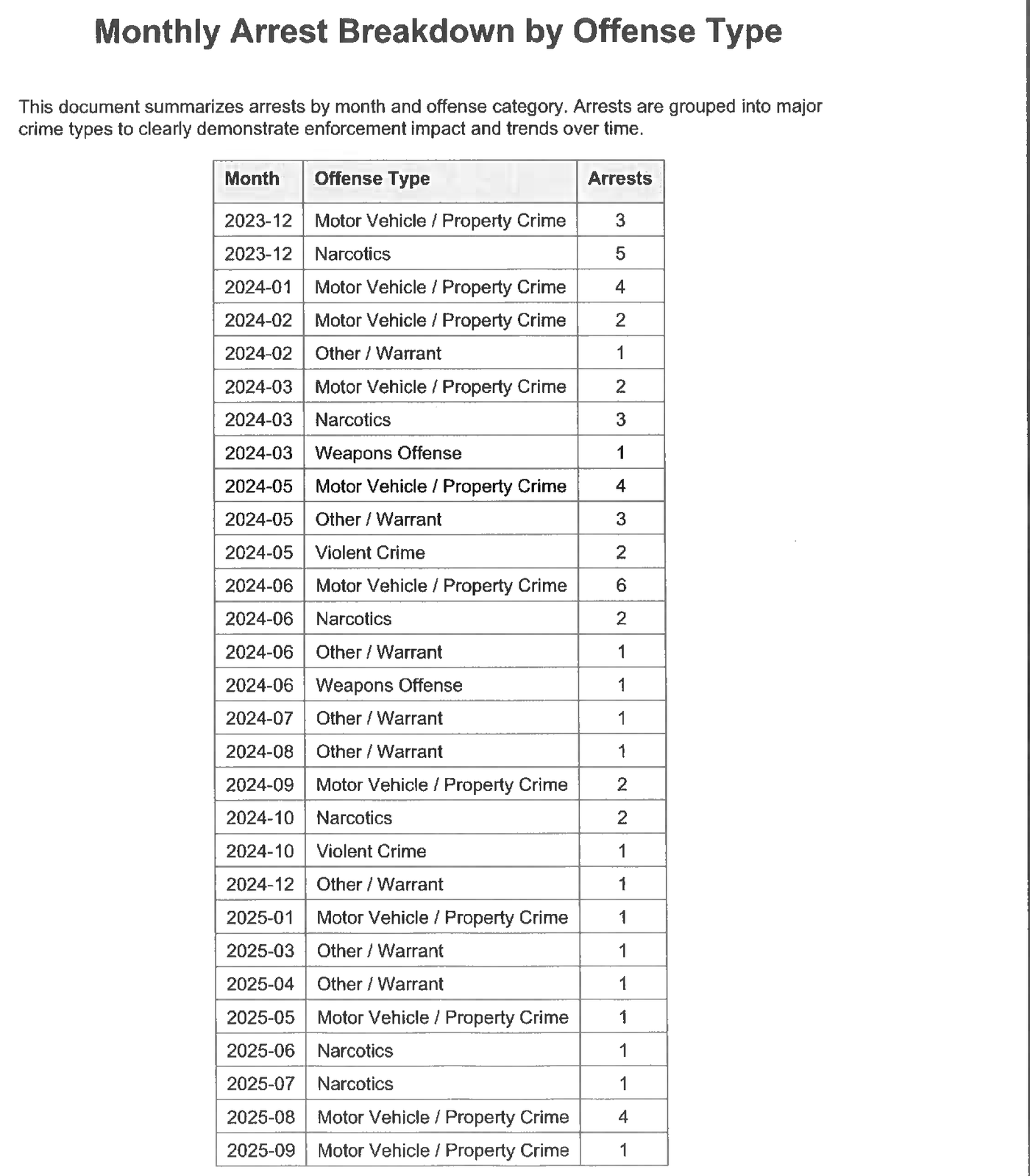
    The handout gives no numbers. The department has them. The same January 30 email attached a table of every arrest from a camera hit since December 2023.

    The total is 73 arrests in 26 months. That is about 3 a month. 35 were car or property crimes, 21 were drug cases, 11 were warrants, 2 were weapons cases. Four were violent crimes. Three months had none.

    The program costs about $1 million a year, about 13 police officer salaries. In 2025 alone, officers ran about 17,500 searches. The department counted 23 arrests from camera hits that year.

    73

    arrests from camera hits in 26 months, 4 of them violent

    The department's own table

    "Monthly Arrest Breakdown by Offense Type," attached to the January 30, 2026 email. Every arrest from a camera hit since December 2023, by month. Tap to open page 3 and page 4.

    The police department's own table titled Monthly Arrest Breakdown by Offense Type, listing arrests from license plate reader hits by month from December 2023 onward.

    See the evidence yourself

  11. 11

    They say

    “To date state and federal courts have determined it is not a violation of the Fourth Amendment.”
    Handout, page 8

    Evidence tells another story

    The biggest Flock case in the country is not over. Two Norfolk, Virginia residents sued over 176 Flock cameras. In February 2025 the court said their claim of dragnet surveillance was plausible enough to go forward. In January 2026 the judge ruled for the city. They appealed. The appeal is pending right now.

    Read the judge's reason. He said 176 cameras did not capture "the whole" of a person's movements. Norfolk has about 240,000 people. Casa Grande is planning about 240 devices for about 60,000 people. That is roughly four times the cameras per person, plus 100 video cameras that never stop recording, plus drones.

    The Supreme Court has already said that tracking a car with a GPS device for 28 days is a search, and that pulling months of phone location history is a search. Nobody has ruled on a network this dense. "Not yet ruled unconstitutional" is not "constitutional."

    176

    Norfolk cameras a judge called too few to track "the whole" of a life

    See the evidence yourself

  12. 12

    They say

    “No. The cameras are not photo radar cameras and do not issue citations for any violations.”
    Handout, page 4

    Evidence tells another story

    You do not need radar to measure speed. Every camera knows its location and stamps the exact time on every photo. Two cameras on the same road give distance and time. Distance divided by time is speed. That is how average-speed enforcement works.

    Flock's own FAQ says its cameras "do not currently measure vehicle speed." Currently. Flock already sells trailers that combine plate reading with speed feedback.

    "Do not issue citations" is not "not used for traffic enforcement." Local reporting described a two-day traffic crackdown using Safe City camera and drone data. The January 2026 log has searches labeled "Traffic Infraction" with the case number "none." The January 30 email says footage was used to determine the cause of traffic collisions.

    60+

    arrests and citations in a two-day traffic crackdown that used Safe City cameras and drones

    See the evidence yourself

More claims from the handout

Same pattern. Shorter.

Real-time tracking and watch lists

“Casa Grande PD Flock ALPR cameras do not: Track a vehicle by GPS in real time.”
Handout, page 5

The cameras are the GPS. Each one knows where it is. When a plate on a watch list passes, an alert fires with the location and the time. With cameras on every main road, that is real-time tracking of any car on a list.

Any authorized user can create a custom watch list, and an entry can stay active for 30 days without a supervisor's permission. Officers in other cities used exactly this kind of feature to track ex-partners.

Everyone not on a list gets a searchable 30-day history instead.

Ask the council: How many custom watch-list entries exist right now, and who audits them?

Phones and other signals

“Casa Grande PD Flock ALPR cameras do not: Track a person's phone.”
Handout, page 5

Not today. But the plate-camera industry already sells bolt-on sensors that do. Leonardo's ELSAG SignalTrace reads Bluetooth, Wi-Fi, RFID, and tire-pressure-sensor signals from passing cars and links them to the plate read.

Flock does not sell that yet. Nothing in the handout, the contract, or the policy forbids adding one to the same poles. "Do not" describes today's hardware, not a rule.

The cameras do notice people. Flock's patent describes an infrared motion detector that triggers the camera when anything moves in front of it. The handout admits people appear in the images.

Ask the council: Will the council require a public vote before any new sensor type is added to the network?

Video and drone sharing

“Data from PTZ or Drone Cameras are not shared with any other agencies.”
Handout, page 6

The department's own policy describes its Real Time Information Center as a "liaison with other RTICs" that provides "real-time information to partner agencies requiring Casa Grande Police Department (CGPD) information."

Video also sits on Flock's servers under the same contract license as everything else.

Ask the council: Which partner agencies have received real-time video or drone information, and under what agreement?

Who can access the system

“Access is limited to authorized personnel who have a legitimate law enforcement or public safety reason to use the system.”
Handout, page 7

The policy allows "sworn personnel or professional staff." The Real Time Information Center is run by "public safety professionals," which can mean civilians. The school camera agreement never defines "Authorized Users" at all.

Flock employees have accessed customer cameras too. In Dunwoody, Georgia, Flock staff viewed cameras at a children's gym, a playground, and a school as a sales demo.

The released logs show dozens of different user names running searches.

Ask the council: How many accounts exist today? How many belong to civilians, interns, volunteers, contractors, or Flock employees?

The one complaint

“To date, CGPD has received one citizen complaint alleging misuse of the ALPR system. The department conducted a thorough investigation, and the officer involved was fully exonerated of any misuse.”
Handout, page 8

The department investigated itself and cleared itself. The handout does not say who investigated, what standard they used, or whether anyone outside the department reviewed it.

The handout says misuse can lead to "loss of access, an internal investigation, disciplinary action, or termination." It never says prosecution. Police in at least 20 other departments have used these systems to stalk people.

Ask the council: Who investigated the complaint, what was alleged, and will the file be released? Will misuse be referred for prosecution, not just discipline?

Nothing in the handout is binding

“On September 15, 2025, City Council voted to approve the contract and use of funds for the program. ... CGPD reviews its policy and procedures as needed.”
Handout, page 10

The council approved money, not rules. Every promise in this handout comes from a department policy that the department can change "as needed," with no council vote and no public notice.

The council can fix that. It can pass an ordinance with warrants for location-history searches, a ban on people searches and federal immigration searches, a shorter retention period, outside audits with public results, and real penalties for misuse.

Ask the council: Will the council adopt a binding ordinance instead of accepting a briefing?

Retention is getting longer, not shorter

“The Police Department is currently evaluating the 30-day retention period to determine whether it continues to provide the appropriate balance between investigative value, public safety, privacy, and responsible data management.”
Handout, page 6

That sentence signals a longer retention period. Anything downloaded as evidence is already kept for years under state records rules, and the contract lets Flock keep what its AI learns from the footage forever.

The handout never explains why 30 days is the floor instead of the ceiling.

Ask the council: Why not 7 days? Who decides, and will the public be told before retention changes?

Where the cameras went

“The cameras are placed strategically on major thoroughfares and arterial roadways to maximize effectiveness and coverage for the city. ... Camera locations were selected by evaluating call-for-service data from previous years.”
Handout, page 3

Look at the camera map at deflock.org, where residents across the country pin the cameras they find. Its count for Casa Grande: Mission Royale has about 5 cameras for roughly 2 square miles of homes. Downtown has about 17 in roughly 1 square mile. Val Vista Boulevard, where the police station sits, has none. Check it yourself.

No council vote and no public meeting decided where the cameras went. One deputy chief reviews locations once a year. There is no rule about schools, places of worship, clinics, or the courthouse. The elementary schools are already connected.

Ask the council: Release the placement analysis and the call-for-service data by neighborhood, and explain why the deflock.org map shows about 17 cameras downtown and none on Val Vista by the police station. Adopt a rule for sensitive locations like schools, places of worship, and clinics.

Drones

“DFR drones are not used for routine patrol.”
Handout, page 2

The drones are Flock too. Flock bought the drone company Aerodome in 2024. The handout never says so, and the city's flight dashboard is on aerodome.com.

A drone flying to a call passes over every backyard, pool, and patio on the way. The policy only bars "intentionally" steering cameras into private areas. Footage picked up along the way is kept under the same rules and sits in the same searchable system.

Ask the council: How many flights so far, and for what kinds of calls? Is drone video searchable with FreeForm? What happens to footage of homes that had nothing to do with the call?

Before you go

Come Tuesday. Bring a neighbor. Bring this page.

1

Arrive at 6:00 PM

The doors open 15 minutes early. A full room at the study session tells the council that residents are watching.

2

You cannot speak at 6:00

The study session has no public comment. Listen for the claims on this page and note what the Chief says about each one.

3

You can speak at 7:00

The regular council meeting has public comment. Say your name and address, then make one or two points. Three minutes is plenty.

4

Bring it in writing

A written statement with your name and address carries the same weight as a speech.